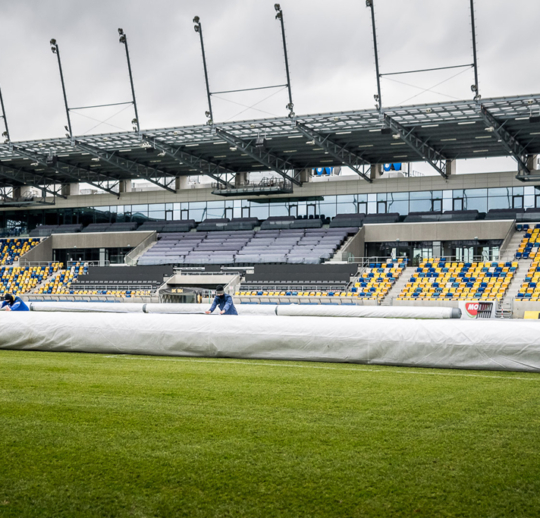
Summer is here which usually means holidays for many, but for those involved in maintaining football pitches it is a very busy time.
And even though 3G or 4G artificial pitches are very much in the media spotlight most football pitches across the footballing world are still made of natural turf.
Keeping all those pitches serviceable is the work of the Groundstaff. Professional or volunteer, paid or not the Groundstaff enable football to be played.
However, if you play football in a country with a temperate climate then you can guarantee that the weather will play its part. Understanding how pitch covers help keep fixture disruption to a minimum is crucial for the groundstaff.
Football Pitches now fall into 3 main categories:
Natural Grass
Hybrid (95% natural turf with the rest a synthetic addition)
Artificial Pitches (3G or 4G standard)
So how can maintenance and pitch protection affect the performance of natural turf pitches?
Sport England identify 4 main types of natural turf construction.
Undrained – Typical of many council run pitches. Usually only adequate for regular use if the subsoil levels are naturally well drained. Prone to overuse and waterlogging and freezing.
Pipe drained pitches – Common system with the better maintained amateur, semi-pro and older professional pitches. Perforated plastic pipes are laid approx. 50-60cm below the playing surface. The pipes will tend to lie on gravel trenches and usually connect to a water drainage system. Work well if well maintained but are prone to overuse.
Pipe and slit drained pitches – A development on the pipe drained system. Gravel filled slit trenches are laid across the top of the pipes. The slits are covered with sand drainage. These pitches are relatively common but regular maintenance is required as frequent sand dressing is needed to keep the surface playable for longer periods. Are more labour intensive than the previous two types.
Suspended water table pitches – Use by professional clubs these pitches are constructed over a gravel base piped drainage system. Water is held at root level to help keep moisture in the grass. Usually serviced via an automatic irrigation system these pitches are highly technical and need a high level of maintenance to keep them in tip top condition.
The problem with all of these pitches is if the soil sub layers are damaged or worn they can all fall foul of the weather. Therefore protecting the sub layers is just as important as protecting the surface.
This is where pitch protection can really make a difference. Controlling the amount of water getting onto a pitch will not only protect at grass level but also will help protect the sub-soil levels. Using the right type of pitch cover is crucial here. The cover needs to be waterproof but must also allow enough light through to encourage germination without scorching the surface.
Plus using waterproof covers provides the physical barrier needed to keep snow and ice off the playing surface so reducing waterlogging issues even further.
Matchsaver Pitch Protection have worked with clubs and agronomists to provide pitch covering solutions that maintain that balance between effectiveness and everyday practicality.
Call Matchsaver on +44 (0) 3458 721800 and talk to us about protecting your pitch.
 International



 Belgique
  Danmark
  Suomi
Suomi  France
  Deutschland
  Italia
  Nederlands
  Norge
Norge  Polska
  ROI | Eire
  Russia
  Espana
  Sverige
  Swiss
Swiss  United Kingdom
  Rest of Europe